Clinical practice management and insurance billing
A practice management platform for ABA therapy providers — clinical data collection, scheduling, and a full insurance claims pipeline in one system.
Figures measured directly from the project repository.
An ABA therapy provider carries an unusual operational burden. Clinicians collect fine-grained behavioral data during every session — trial-by-trial, often minute-by-minute. Scheduling has to reconcile therapist credentials, service locations, patient availability, and authorization limits. And the money arrives through a maze of payers: private insurance, regional centers, school districts, Easter Seals, and private pay, each with its own rules about what can be billed and how.
Most providers stitch this together from a clinical data app, a scheduling tool, and a billing service that don’t talk to each other. The gaps between them are where revenue quietly leaks: sessions delivered but never billed, claims denied for reasons nobody traced back, authorizations exhausted without anyone noticing.
GoLotus consolidated the entire operation into a single multi-tenant platform, organized around three subsystems that share one data model.
The clinical layer models the actual practice of behavioral therapy rather than approximating it. Patients have goals organized into collections; therapists record progress against those goals using eighteen distinct charting strategies — cold probe, mand, mand-echoic, task analysis, time sampling, duration, articulation, preference assessment, tally and percentage variants, and more. Each is a first-class chart type with its own data capture and rendering.
Sessions produce SOAP notes with signature capture. Trackers and per-organization tracker customizations let each provider adapt the data collection to their own clinical protocols without a code change.
Appointments are generated from templates and recurring rules, constrained by therapist credentials, appointment types, service locations, and centers. A blackout system handles the exceptions — holidays, closures, therapist unavailability — that make naive recurrence models fall apart in practice.
This was the hardest and most valuable part of the system. We built a payer-aware charging layer: a charger factory resolves the correct billing strategy per funding source, with distinct implementations for insurance providers, regional centers, schools, Easter Seals, manual private pay, and standard private pay. Each encodes its own rules about what is billable and at what rate.
From there, delivered services flow through charges and line items into either invoices or insurance claims. Claims are assembled against CPT codes and diagnoses, submitted electronically through the PokitDok clearinghouse, and reconciled against claim responses as they return — with eligibility verified up front through Eligible. Stripe via Cashier handles card payments and subscriptions; TaxJar handles tax.
The result is a closed loop: a session recorded by a therapist on Monday becomes a correctly-coded claim without anyone re-keying it.
Each organization’s data is isolated, with managed groups, organization-scoped users, and a role and permission model layered on top so a therapist, a supervisor, and a billing administrator each see only what they should. Laravel Auditing records changes across the system — a non-negotiable in a clinical context.
At 7,344 commits and 182 migrations across three years, GoLotus was the largest system our team has built. That scale demanded structural discipline: the billing logic lives in its own Billing namespace with clear seams between chargers, claim assembly, and invoicing, and the charting system is a factory over a common interface rather than a switch statement that grows forever.
We used Laravel Nova for the administrative surface, which let a small team put a capable back office in front of 56 models without hand-building CRUD for each one — and freed that effort for the billing engine, where the real complexity lived. A REST API backed the Vue front end and left the door open for future clients.
Seven engineers contributed over the life of the project, with work distributed across clinical tooling, billing, and platform. That breadth is why the domain modelling was worth the up-front investment: it was the shared contract that let people work in parallel.
The heaviest build phase ran from 2018 to 2021, delivering the full clinical, scheduling, and revenue-cycle system end to end. We’ve stayed with the platform since, keeping it running and evolving alongside the practices that use it.
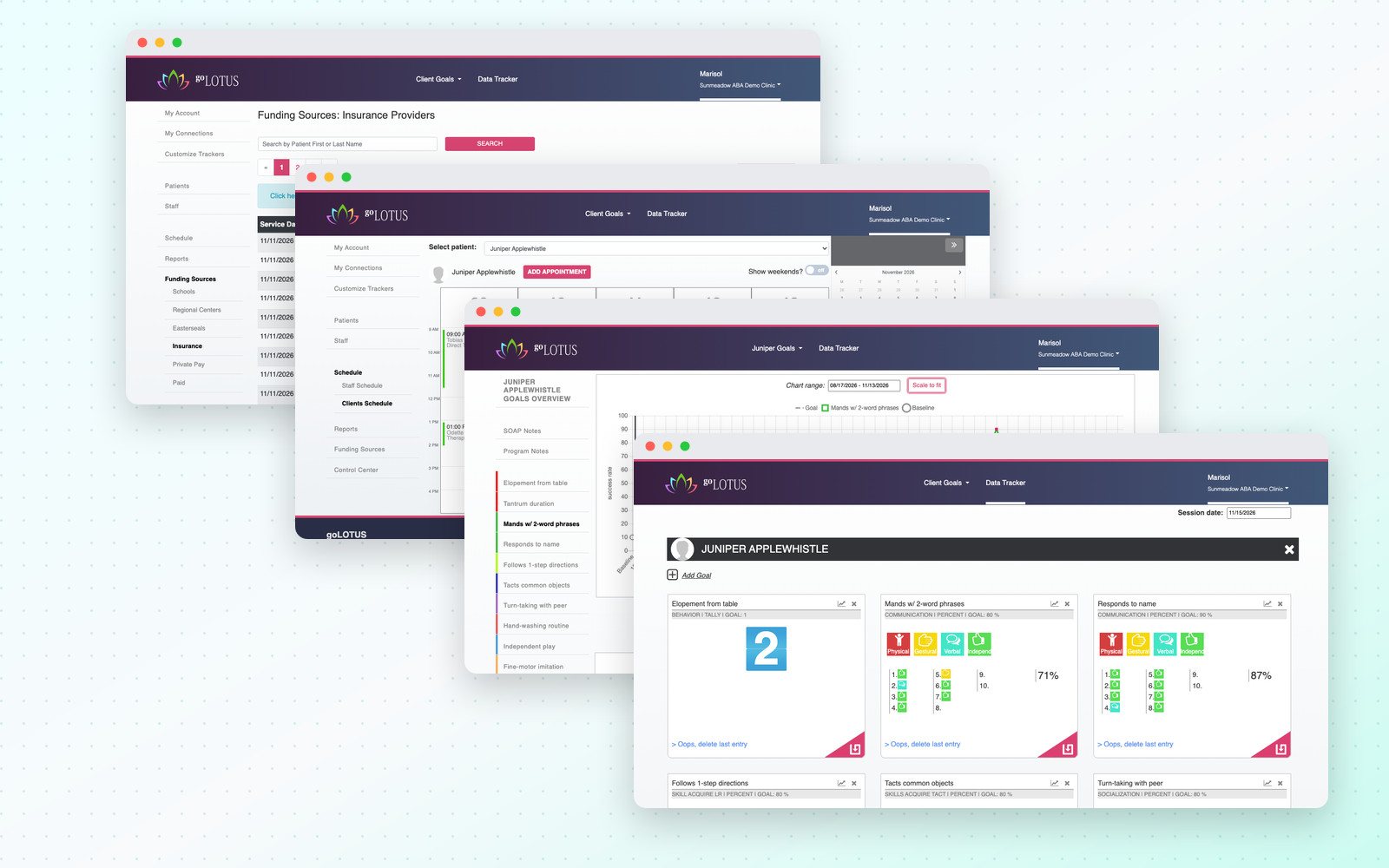
The system as it actually runs in production.
Whether you have a fully-formed spec or just an idea on a napkin, we'll help you turn it into a product your users love.
