Quote-to-crush vehicle operations platform
An operations platform that takes a scrap vehicle from instant online quote through tow, teardown, and resale — with a state machine tracking every car in the yard.
Figures measured directly from the project repository.
An auto recycler makes money on the spread between what it pays for a scrap vehicle and what it recovers from the parts, the scrap metal, and the fluids. Getting that spread right depends on three things happening quickly and correctly: quoting the car accurately before a competitor does, getting a truck to it, and knowing exactly what state every vehicle in the yard is in.
Traditionally each of those lives somewhere different — a phone call and a mental price list for the quote, a whiteboard for dispatch, and a spreadsheet (or nothing) for inventory. The failure mode is expensive and mundane: a quote priced from a stale scrap rate, a driver sent to the wrong side of the service area, a car that sat for three weeks because nobody remembered it was waiting on a drain report.
A single platform covering the whole lifecycle, from a customer’s first click to the vehicle leaving the yard.
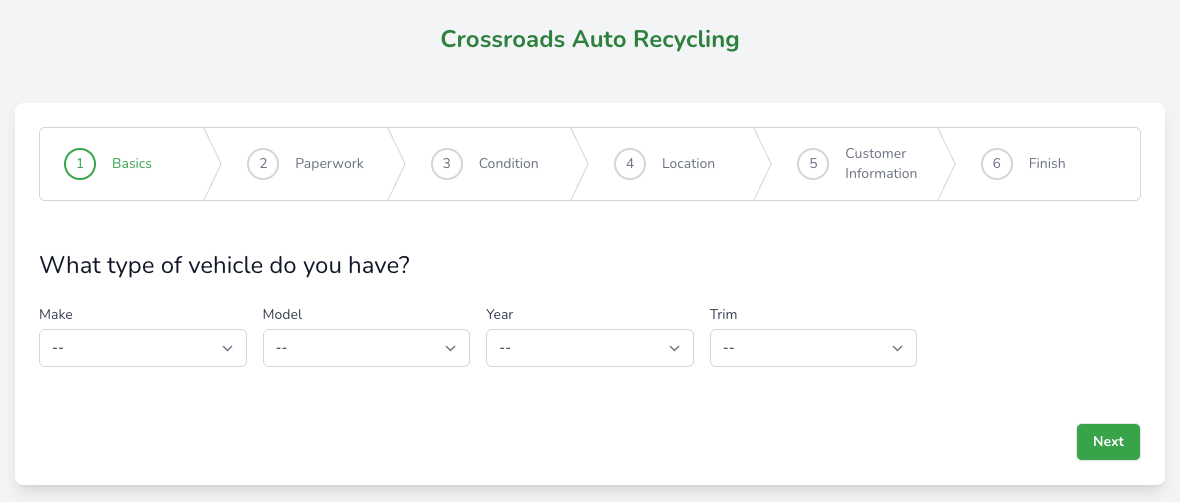
A customer enters their vehicle through a guided wizard. Rather than asking them to know their car’s specifications, the system decodes the VIN against the NHTSA vehicle database to establish make, model, year, and curb weight automatically — and on a phone, the VIN can be captured by pointing the camera at the barcode rather than typing seventeen characters.
Pricing is then computed from a maintained scrap price table with a modifier system layered on top: adjustments for damage, missing components, condition, and location, all tunable by the business from the admin without a code change. A damage selector captures condition visually, and customers attach photos to support the quote.
Repeat customers are recognized at quote time — a meaningful signal in a business where the same tow operators and dealers come back regularly.
A quote nobody accepts is worthless, so the system chases them. Queued jobs fire on a schedule — after a quote is viewed but not accepted, three days after issue, and again before expiration — so follow-up happens without anyone remembering to do it.
Accepted quotes become pickups, scheduled against a calendar and constrained by service area groups with Google Maps integration, plus an unavailability model covering driver time off and closures.
Drivers get their own purpose-built flow rather than a stripped-down version of the admin: start pickup, start towing, complete, or cancel. It’s built for someone standing next to a car with one hand free, not for a desk.
The heart of the system is a formal state machine over inventory. Every vehicle moves through explicitly modelled states — intent, in stock, evaluation report assigned and completed, scrap drain report assigned and completed, pending parts, processed parts, pending repair, repaired, pending scrap, pending crush, crushed, pending sale, sold — with transitions enforced in code rather than by convention.
This is the difference between a status column that drifts out of sync with reality and a system that can’t represent an impossible situation. It also makes the yard legible: at any moment, the business can answer how many cars are waiting on a drain report, or how long the average vehicle sits between teardown and crush.
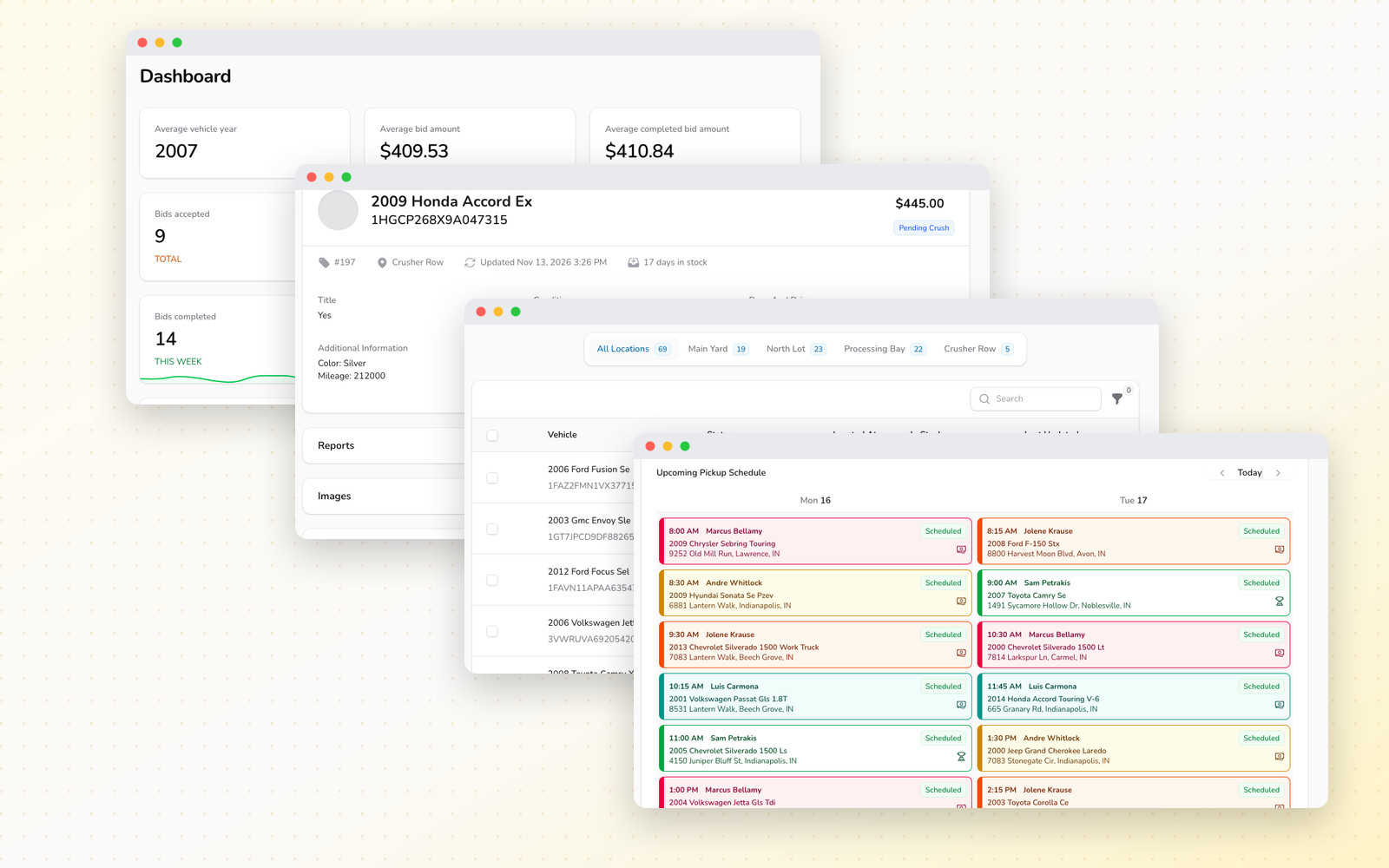
Evaluation reports, scrap drain reports, and media reports attach to vehicles as they move, and dashboard widgets track bid amounts and bid trends over time.
The platform now runs a second brand alongside Crossroads on the same codebase, with per-brand domains and theming. New quote-taking operations launch without forking the system.
The single most consequential decision was modelling inventory state explicitly with Spatie’s model-states package instead of a status enum. It cost more up front and it is the reason the system has stayed coherent for five years while the operational process around it changed.
We used Filament for the internal application, which put a serious operations back office — inventory, bids, pickups, drivers, service requests, locations, pricing, reporting — in reach of a three-person team, while the customer-facing quote wizard and the driver flows are custom Livewire built specifically for their contexts.
The project is maintained in the same continuous-upgrade style as the rest of our work: it has moved through Laravel majors and, most recently, a major Filament upgrade, backed by 77 Pest tests and Rector for automated refactoring.
Actively developed and in daily production use. Recent work has focused on the Filament upgrade and on bringing richer imagery into the inventory views.
The system as it actually runs in production.
Screens captured from the running application.
Whether you have a fully-formed spec or just an idea on a napkin, we'll help you turn it into a product your users love.
