Industrial condition monitoring and diagnostics
A predictive maintenance platform that turns oil and vibration lab results into graded diagnoses automatically — bilingual, and running on ten custom-built extensions.
Figures measured directly from the project repository.
Condition monitoring is how heavy industry avoids catastrophic failure. You sample the oil from a gearbox, send it to a lab, and read the results: iron, copper, silicon, viscosity, water content, particle counts. Read correctly and in time, those numbers tell you a bearing is failing weeks before it does.
The difficulty is in “read correctly.” A silicon reading that’s alarming in a hydraulic system is unremarkable in a diesel engine. The same value means different things depending on the oil type, the machine, and — critically — that machine’s own established baseline. So the interpretation was done by hand, by experienced engineers, against reference tables. That approach doesn’t scale, it’s slow, and the expertise lives in people’s heads rather than in the business.
CBC serves an industrial client base across Taiwan, which added a second requirement: whatever we built had to work equally well in Traditional Chinese and English.
A platform that ingests lab results, grades them automatically, and produces client-ready diagnostic reports.
The core of the system is a configurable diagnostic engine. Rules own a set of formulas, and each formula is matched to a specific measured field and lubricant oil type. Crucially, formulas can be gated on a baseline threshold — a formula may apply only when the machine’s established baseline for that field is above, or below, a given value. Resolution happens at analysis time: given a field, an oil type, and the machine’s baseline, the engine selects the formula that applies and grades the sample.
That design is the whole point of the project. Engineering knowledge that previously lived in reference binders and senior engineers’ judgment became data in the system — editable by CBC’s own experts through an admin interface, with no developer involvement and no deployment. When a client requires a distinct rule set, it becomes another configured set of rules rather than a fork of the codebase.
Sample validation is handled properly too, with dedicated validators for ISO 4406 and NAS 1638 cleanliness codes.
Results are meaningless without knowing what they came from, so the system models the physical world: companies own plants, plants contain areas, areas contain machines, and machines have lubricant types and their own baseline analyses. Oil analyses and vibration reports attach to machines, which is what makes trend-over-time and baseline comparison possible.
An alerts subsystem surfaces conditions that need attention rather than requiring someone to go looking. Alerts are attached to resources throughout the interface, so a problem is visible where the user already is.
Industrial clients want documents. We built report generation on PHPWord with DOCX and RTF conversion in both directions, plus Excel export paths for bulk data. Vibration reports are uploaded and parsed into structured content rather than stored as opaque attachments.
The application ships in English and Traditional Chinese throughout — not just the interface strings but the generated reports — with a custom locale switcher so users move between them freely.
CBC is the clearest example in our portfolio of a project where the right answer was to build our own tools. The application runs on Laravel Nova, and rather than fight the framework’s constraints we extended it, shipping ten custom Nova packages as first-class, separately-versioned components:
Packaging these separately rather than as application-level hacks meant each could be tested, versioned, and reasoned about on its own — and it’s a large part of why a seven-year-old codebase is still comfortable to work in.
End-to-end coverage is provided by Cypress, with dedicated database seeders for test scenarios, plus seeders for the standard and client-specific rule sets so a full diagnostic environment can be reconstructed from scratch.
In continuous production since 2018 and still actively developed. Recent work has centred on new client-specific analysis reports and on diagnosis handling — the system’s core value, still being sharpened seven years in.
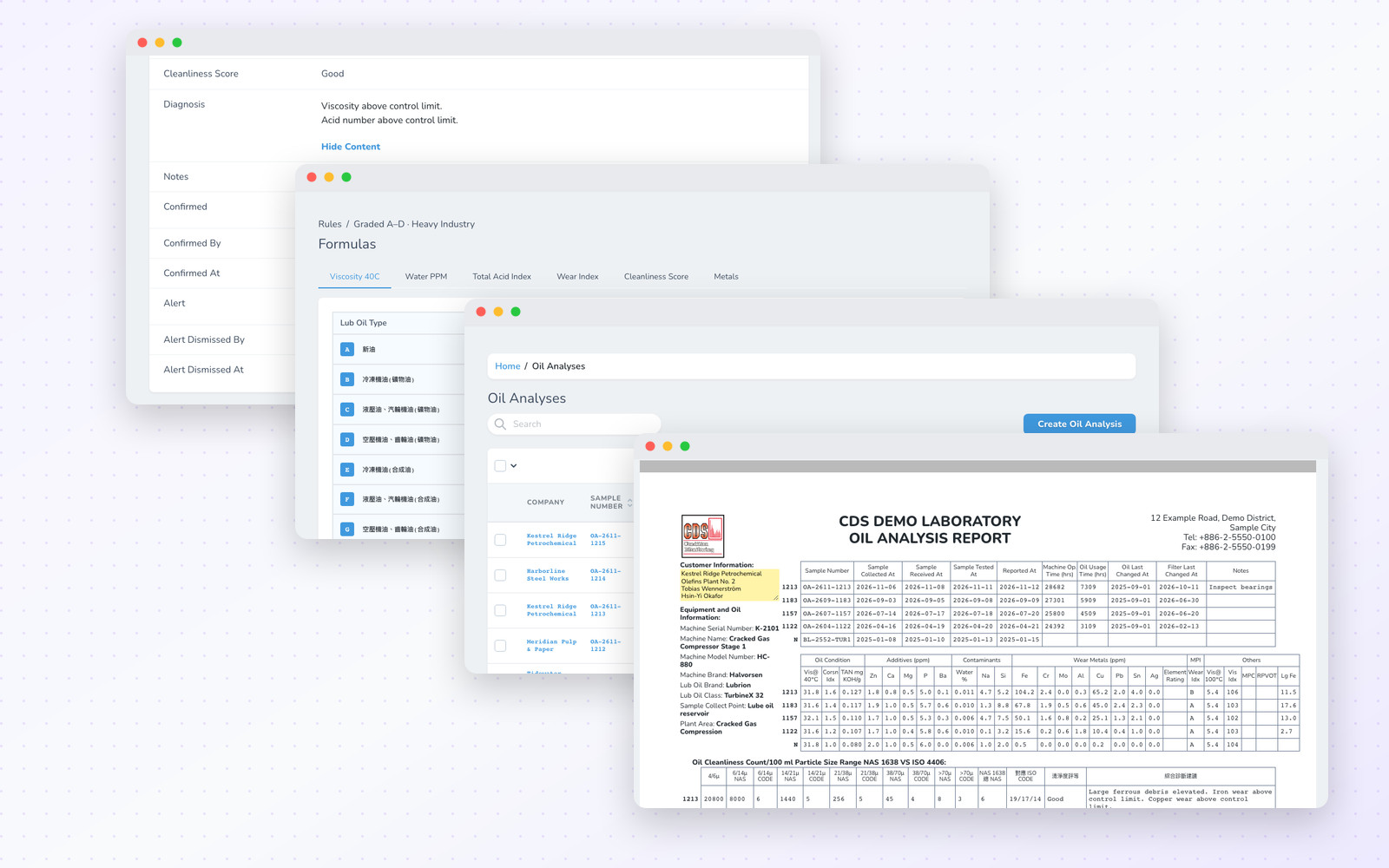
The system as it actually runs in production.
Whether you have a fully-formed spec or just an idea on a napkin, we'll help you turn it into a product your users love.
